

1099-MISC Reporting Requirements: A Small Business Guide
If you own a small business, understanding 1099-MISC reporting requirements is essential to staying compliant with the IRS. Each year, businesses must report certain payments made to contractors, vendors, and others using the correct 1099 form. Getting this wrong carries real penalties — and the rules around this form have changed significantly in recent years.
What Small Business Owners Need to Know
The 1099-MISC form has been around for decades, but many small business owners still confuse it with the newer 1099-NEC. Understanding which form applies to which payment type is the starting point for staying compliant.
The IRS redesigned the 1099-MISC in 2020 when it introduced Form 1099-NEC. Before that change, businesses reported non-employee compensation — payments to independent contractors — in Box 7 of the 1099-MISC. Today, non-employee compensation goes on Form 1099-NEC. The 1099-MISC still exists, but it now covers different payment types.
What Does 1099-MISC Cover Today?
Use Form 1099-MISC to report the following payments of $600 or more made during the tax year:
- Rent payments
- Royalties ($10 or more)
- Prizes and awards
- Medical and healthcare payments
- Payments to an attorney
- Other income payments
If you paid an independent contractor or freelancer $600 or more for services, that goes on Form 1099-NEC — not 1099-MISC. This is the most common mistake small business owners make.
1099-MISC vs 1099-NEC: The Key Difference
The simplest way to remember the distinction: 1099-NEC is for people who did work for you. 1099-MISC is for everything else — rent, royalties, prizes, and certain other payments.
Both forms have different deadlines, which makes it even more important to know which one applies to each payment you made during the year.
Current Filing Deadlines
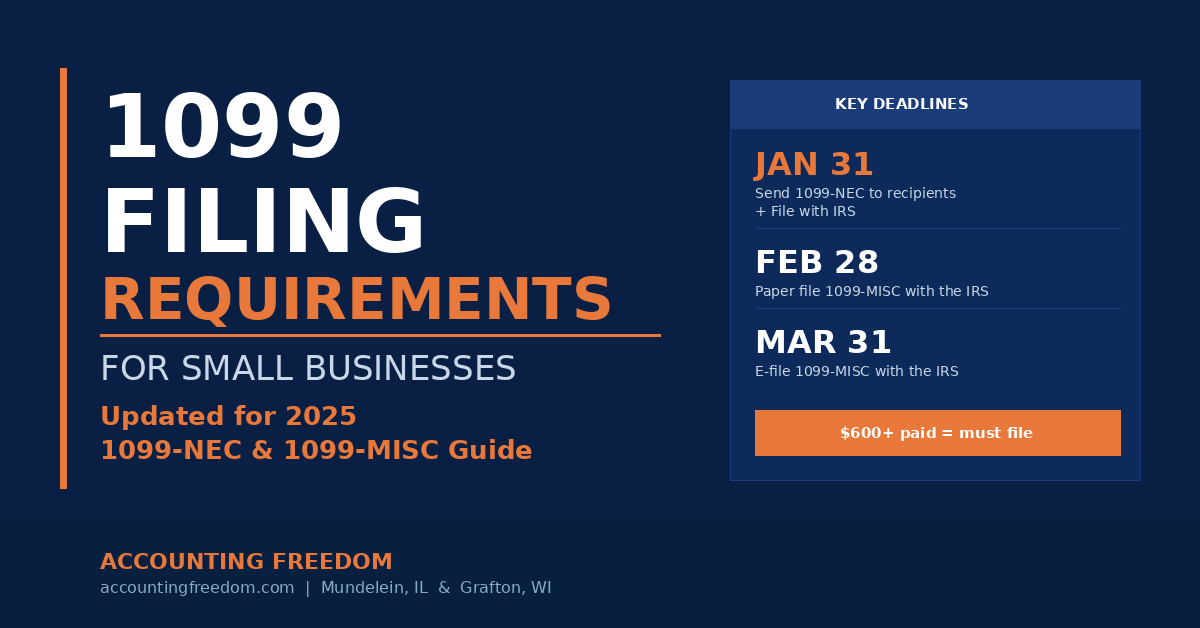
Missing a 1099-MISC deadline is an easy way to trigger IRS penalties. Here are the current deadlines:
- January 31 — Send Form 1099-NEC to recipients and file with the IRS
- February 28 — Deadline to paper file Form 1099-MISC with the IRS
- March 31 — Deadline to e-file Form 1099-MISC with the IRS
Note that the January 31 deadline applies to 1099-NEC, not 1099-MISC. If you only file 1099-MISC forms, your deadline is February 28 for paper filing or March 31 for electronic filing. No extensions are available once you miss these dates.
Who Must Receive One?
1099-MISC reporting requirements apply when you pay $600 or more to any of the following during the tax year:
- Landlords or property owners (rent payments)
- Attorneys (even if incorporated)
- Medical or healthcare providers
- Prize or award recipients
Payments to most corporations are exempt from reporting. Attorneys are a notable exception — you must file a this form for attorney payments regardless of whether they operate as a corporation.
Collecting the Right Information
Meeting your 1099-MISC reporting requirements starts with collecting the right information from payees before you issue any payment. Require every vendor, landlord, or contractor to complete a Form W-9 before receiving their first check. The W-9 captures their legal name, address, and taxpayer identification number — everything you need to file accurate 1099 forms at year end.
If you wait until January to chase down W-9s, you’re already behind. Build the W-9 request into your vendor onboarding process so it happens automatically every time.
Here’s a direct link to Form W-9 from the IRS website.
Penalties for Missing 1099-MISC Reporting Requirements
The IRS does not take non-compliance lightly. Penalties depend on how late you file:
- $60 per form — filed within 30 days of the deadline
- $130 per form — filed more than 30 days late but before August 1
- $310 per form — filed after August 1 or not filed at all
- $630 per form minimum — intentional disregard, with no maximum cap
If you have ten contractors and miss the deadline, you’re looking at $600 to $3,100 in penalties before the IRS even starts asking questions. The cost of staying compliant is far less.
Common 1099-MISC Mistakes Small Businesses Make
Even businesses that intend to comply often make avoidable errors. Watch out for these:
- Using 1099-MISC instead of 1099-NEC for contractor payments
- Missing the difference in deadlines between the two forms
- Failing to collect W-9s before issuing payments
- Not filing for attorney payments because the firm is incorporated
- Entering the wrong taxpayer identification number from an outdated W-9
Any of these mistakes can trigger IRS notices, penalty assessments, or backup withholding requirements.
Frequently Asked Questions
Do I need to file 1099-MISC for payments made through PayPal or Venmo? No. Payments made through third-party payment processors like PayPal, Venmo, or credit cards are reported by the processor on Form 1099-K. You do not file a separate 1099-MISC for those transactions.
What if I filed the wrong 1099 form? File a corrected form as soon as you catch the error. Check the “Corrected” box at the top of the new form and send copies to both the IRS and the recipient.
Do I need to file 1099-MISC for a one-time payment? Yes, if the payment was $600 or more and meets the reporting criteria. The number of transactions doesn’t matter — only the total amount paid during the year.
Need Help Staying Compliant?
1099-MISC compliance has more moving parts than it looks — especially if you make multiple types of payments, work with many vendors, or are unsure which form applies to a specific situation. Our accounting team works with small businesses across Illinois and Wisconsin year-round to stay ahead of IRS deadlines, avoid penalties, and keep records clean. If you have questions about your reporting requirements, reach out — we’re here to help.