

C Corp Salary vs. Dividends: How to Pay Yourself and Keep Compensation “Reasonable” (2026)
Last updated [PUBLISH DATE], 2026 — If you own an incorporated business, the choice between salary vs. dividends has a real answer, and it’s worth understanding before you decide how to pay yourself this year. There’s a genuine tax advantage built into taking money out as salary rather than dividends. A corporation can deduct the salaries and bonuses it pays executives, but it can’t deduct dividend payments. Dividends get taxed twice — once at the corporate level, once again when the shareholder receives them. Compensation paid as salary is only taxed once, to the employee who receives it.
There’s a limit to how far you can push this, however. Compensation is only deductible to the extent the IRS considers it reasonable. Push salary too high relative to what the role actually justifies, and the excess can be reclassified as a disguised dividend. That erases the tax advantage you were trying to capture in the first place.
The short version: Choosing between salary vs. dividends isn’t really a choice between two equal options. Salary is deductible to the corporation, dividends aren’t. That makes salary generally more tax-efficient, up to the point where compensation stops looking reasonable. The federal corporate tax rate remains a flat 21% in 2026. The IRS evaluates “reasonable” compensation using a facts-and-circumstances test: industry comparables, the employee’s actual duties and time invested, and whether an outside investor would consider the return on equity acceptable after paying that compensation. Four practical steps meaningfully reduce your audit risk: benchmarking against industry pay, documenting your reasoning, avoiding compensation tied directly to ownership percentage, and paying some dividends when the business is profitable.
Salary vs. Dividends: How Double Taxation Actually Works
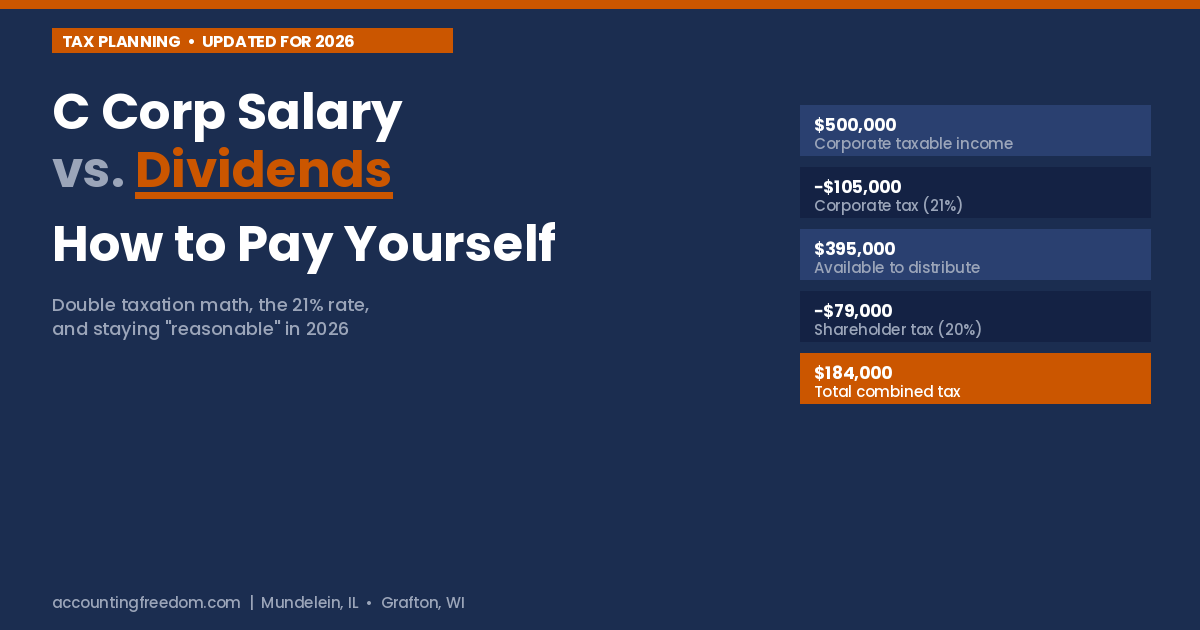
The math behind the C corp salary vs. dividends decision is easier to see with real numbers. Here’s what happens to $500,000 in corporate taxable income depending on how it’s distributed.
| Step | Amount |
|---|---|
| Corporate taxable income | $500,000 |
| Corporate tax (flat 21% federal rate) | $105,000 |
| Remaining profit available to distribute | $395,000 |
| Shareholder-level tax on dividends (20% qualified rate) | $79,000 |
| Total combined tax on distributed profit | $184,000 (36.8% effective rate) |
Compare that to compensation: a salary payment is fully deductible to the corporation, so it reduces corporate taxable income dollar-for-dollar before the 21% corporate tax ever applies. The employee still pays ordinary income tax and payroll taxes on it. But the corporate-level tax on that same dollar disappears entirely. That’s the entire reason this planning question exists. It’s also why the IRS pays close attention when compensation looks designed purely to avoid the corporate-level tax rather than to pay for actual work performed.
Salary vs. Dividends: What Makes Compensation “Reasonable”
There’s no simple formula or safe-harbor percentage for reasonable compensation — despite what you may read elsewhere. If the IRS audits your return, it evaluates the amount similar companies pay for comparable services under similar circumstances. Here’s what factors into that evaluation:
- The employee’s actual duties and the time spent performing them
- Their skills, expertise, and compensation history
- The complexity of the business and its gross and net income
- Whether a hypothetical outside investor would still consider the return on equity acceptable after that compensation was paid
That last factor — sometimes called the “hypothetical outside investor” standard — has become one of the most heavily weighted tests in recent court decisions. The IRS and courts ask: if an unrelated investor owned stock in this company, would they be satisfied with the return left over after this compensation was paid? If compensation is so high that it leaves little or nothing for shareholders, that’s a red flag regardless of how the number was justified.
4 Steps to Protect Your Salary vs. Dividends Strategy
Benchmark Against Industry Comparables
Keep compensation in line with what similar businesses pay executives in comparable roles. Gather and retain whatever evidence you can find to support the number you land on — industry salary surveys, comparable executive compensation studies, or data from professional associations in your field.
Document Your Reasoning at the Time You Decide
In the minutes of your corporation’s board of directors meetings, document the reasons for compensation contemporaneously — not after the fact. If you’re increasing compensation this year to make up for years when it was intentionally kept low, the minutes should say so explicitly. Ideally, the minutes from those earlier low-compensation years should have documented that reduced rate at the time, too. Cite any executive compensation studies or industry data that support your numbers.
Avoid Compensation Tied Directly to Ownership Percentage
Paying compensation in direct proportion to each shareholder’s stock ownership looks exactly like a disguised dividend, and the IRS treats it that way. Say your two 50/50 shareholder-employees are paid identically regardless of their actual roles and time invested. That pattern draws attention.
Pay Some Dividends When the Business Is Profitable
If the corporation is profitable, pay at least some dividends rather than routing all profit through compensation. A profitable corporation that never pays a dividend, year after year, starts to look like every dollar was structured as compensation specifically to dodge the corporate-level tax. That pattern undermines the “reasonable compensation” argument even if every individual number looks defensible on its own.
What This Means for Illinois and Wisconsin C Corp Owners
The salary vs. dividends decision isn’t a one-time choice. It’s worth revisiting every year as your business’s profitability and your role in it change. A compensation level that was clearly reasonable three years ago may look different today. The business may have grown, your responsibilities may have shifted, or industry pay data may have moved.
For Illinois and Wisconsin business owners, this is exactly the kind of decision that benefits from a proactive conversation before year-end. It shouldn’t be a number picked reactively when the tax return is due. Getting it wrong in either direction has real consequences. Too aggressive, and you risk reclassification, back payroll taxes, and penalties. Too conservative, and you’re leaving the deductibility advantage on the table.
For the IRS’s own framing on this topic, see their guidance on reasonable compensation. While that page is written for S corporation officers, the same reasonable-compensation principles apply directly to C corp shareholder-employees.
You can avoid problems and challenges by planning ahead. If you’re not sure whether your current compensation structure would hold up under IRS scrutiny, that’s worth a conversation before your next filing — not after a notice arrives. See what proactive tax planning looks like with our pricing calculator, or use our package assessment to see which tier fits a business at your stage.
Not sure if your C corp compensation would hold up under scrutiny?
A free consultation gets you a real look at your structure — before the IRS takes a look for you.
Schedule a Free Consultation Tax Preparation & PlanningDisclaimer: This article is provided for general informational purposes only and does not constitute tax, legal, accounting, or financial advice. Reasonable compensation determinations are fact-specific and can vary significantly by situation. Before acting on anything in this article, consult with a qualified tax advisor. Reach out to Accounting Freedom for guidance specific to your situation.
About the Author
Frank Fiore, CPA — President & Visionary, Accounting Freedom
Frank Fiore has spent 20+ years helping small business owners in Illinois and Wisconsin navigate entity structure, compensation planning, and tax strategy. Accounting Freedom serves clients from offices in Mundelein, IL and Grafton, WI.