

Fixed Fee vs. Hourly Billing: Which Is Better for Small Businesses?
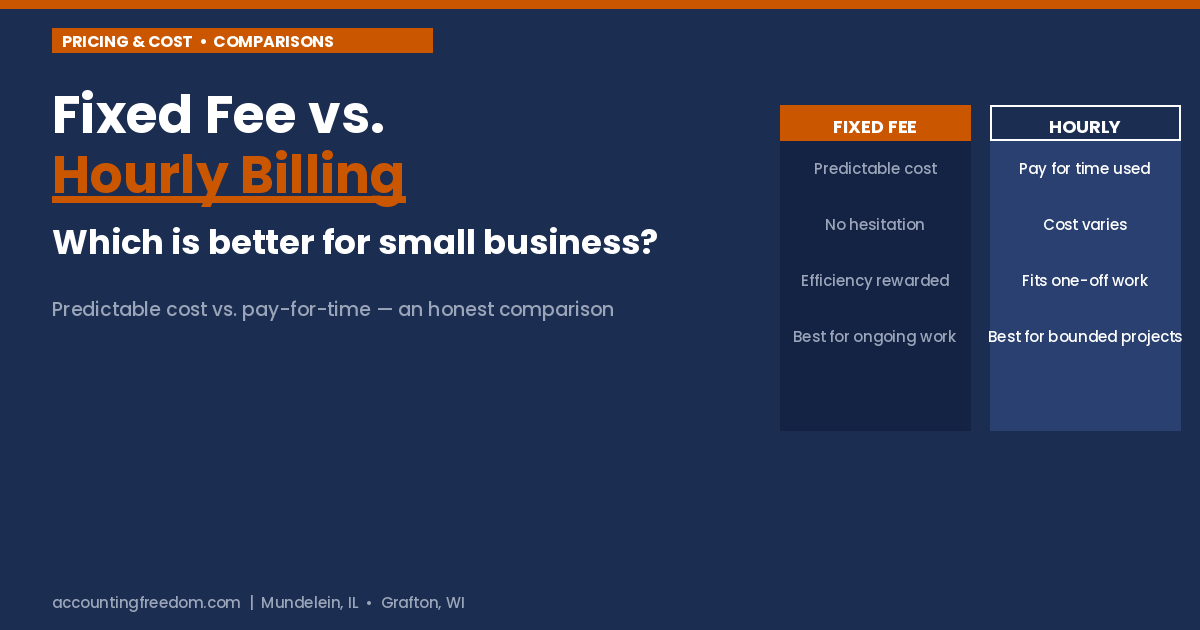
Fixed fee vs. hourly billing is a real decision, not just fine print in an engagement letter. It shapes how often you actually call your accountant and how predictable your monthly costs are. More than most business owners realize, it also determines whether your accountant wants to work efficiently or has a reason to run the clock.
Neither model is inherently better. Rather, each one fits a different kind of work. Here’s how the two actually compare, and which one makes sense for your business.
The short version: Fixed fee billing charges one predictable amount for an agreed scope of ongoing work — monthly bookkeeping, tax prep, and advisory calls included, with no meter running on phone calls or emails. Hourly billing charges for actual time spent, which fits unpredictable, one-off, or highly variable work well but makes monthly costs harder to budget for. Most small businesses running ongoing monthly accounting are better served by fixed fee billing. Hourly billing still makes sense for specific, bounded projects — an IRS audit response, a one-time cleanup, or a complex one-off filing.
How Fixed Fee Billing Works
Fixed fee billing means you pay one set amount — usually monthly — for a defined scope of work. At a typical small business accounting engagement, that scope covers bank reconciliations, monthly financial statements, tax return preparation, and ongoing advisor access by phone or email. Consequently, the cost stays the same whether it’s a quiet month or a busy one.
✓ Strengths
- Predictable monthly cost, easy to budget around
- No hesitation before asking a quick question
- Incentivizes the firm to work efficiently, not to run up hours
- Encourages a closer, more conversational advisor relationship
✗ Watch Out For
- Scope creep — work outside the agreed engagement often costs extra
- A vague or poorly defined scope can lead to disputes about what’s included
- You may pay the same fee in a slow month as a busy one
How Hourly Billing Works
Hourly billing charges for the actual time a firm spends on your work, typically tracked and itemized on a timesheet. Therefore, you pay for exactly what got done — nothing more, nothing less, assuming the estimate was accurate.
✓ Strengths
- Fair for irregular or one-off work where scope is hard to predict upfront
- You only pay for time genuinely spent — no bundled costs for services you don’t use
- Works well for complex, unpredictable situations like an audit response or entity restructuring
✗ Watch Out For
- Costs are unknown until after the work is done
- Creates hesitation — business owners avoid quick questions because “the meter is running”
- Efficiency is quietly penalized: the faster the firm works, the less it earns
- Unpredictable monthly bills make cash flow planning harder
Fixed Fee vs. Hourly Billing: Side-by-Side
| Factor | Fixed Fee | Hourly |
|---|---|---|
| Monthly cost | Predictable, same every month | Variable, known only after the work |
| Asking quick questions | Included — no hesitation | Often triggers a charge |
| Firm’s incentive | Work efficiently, solve problems | Time spent drives revenue |
| Best for | Ongoing monthly accounting relationships | One-off, unpredictable, or bounded projects |
| Budgeting | Easy — same line item every month | Harder — costs shift with scope and time |
| Risk to the client | Scope disputes if work falls outside the engagement | Bill shock if a project runs longer than expected |
The Hidden Cost of Fixed Fee vs. Hourly That Most Owners Miss
The sticker price isn’t the only cost that matters. When every phone call and email carries a potential charge, business owners start hesitating before reaching out — even about things worth flagging early. A quick “is this normal?” question that could catch a problem in month one instead goes unasked. As a result, the same issue shows up as a bigger, more expensive problem by month six.
There’s also an incentive problem worth naming honestly. When a firm gets paid by the hour, working faster doesn’t help their revenue — it actually hurts it. That doesn’t make hourly firms dishonest. It just means the model quietly rewards time spent over problems solved, and those aren’t always the same thing. Research from the American Institute of CPAs on alternative pricing models has found similar patterns across the profession as more firms shift toward value-based and fixed-fee structures.
Fixed Fee vs. Hourly: When Hourly Billing Is Actually Right
Fixed fee billing isn’t automatically the better option in every situation. In fact, hourly billing makes sense for:
- IRS audit response. The scope and duration of an audit are genuinely unpredictable at the outset.
- One-time bookkeeping cleanup. A one-off project with a clear start and end point, not an ongoing relationship.
- Complex, infrequent work. Entity restructuring, a business sale, or a one-time complex filing.
- Occasional, ad hoc help. If you only need an accountant a few times a year, you may not want to pay a full monthly retainer for access you rarely use.
For anything ongoing — monthly bookkeeping, tax planning, an advisory relationship you’ll lean on throughout the year — fixed fee billing is usually the better fit.
Fixed Fee vs. Hourly: What This Means for Your Business
Fixed fee vs. hourly billing isn’t really about which model is objectively superior. Instead, it’s about matching the billing structure to the kind of work you actually need done. Ongoing monthly accounting fits a predictable, all-in fee. Meanwhile, unpredictable, bounded projects fit hourly billing better.
Before signing with any firm, ask directly: is this fixed fee or hourly? What’s included in the fee, and what falls outside it? If it’s hourly, be sure to ask for a not-to-exceed estimate so you aren’t blindsided later. We cover more of these questions in our post on what to ask a CPA before you sign.
At Accounting Freedom, our ongoing accounting relationships run on transparent, published fixed fees — see exactly what each tier costs before you ever get on a call.
Want predictable pricing for your ongoing accounting?
See our published fixed-fee tiers, or talk to us about whether fixed fee or hourly makes more sense for your situation.
See Our Pricing Schedule a Free ConsultationDisclaimer: This article is provided for general informational purposes only and does not constitute tax, legal, accounting, or financial advice. Reach out to Accounting Freedom for guidance specific to your situation.
About the Author
Frank Fiore, CPA — President & Visionary, Accounting Freedom
Frank Fiore has spent 20+ years helping small business owners in Illinois and Wisconsin understand exactly what they’re paying for and why. Accounting Freedom serves clients from offices in Mundelein, IL and Grafton, WI.