

How Much Does Accounting Freedom Cost? Our Packages, Explained
Most small business owners shopping for a CPA can’t get a straight answer about cost. They schedule a discovery call, sit through a sales pitch, and then hear some version of “it depends.” We get it — pricing does depend on a few things. But you deserve to walk in already knowing the ballpark. So here’s what Accounting Freedom cost actually looks like across our three small business packages, what’s included at each level, and how to figure out which one fits your business.
This is the post we wish more accounting firms would write. We work with small businesses across Illinois and Wisconsin — contractors in Lake County, restaurants in Mundelein, family businesses in Grafton, insurance agencies, medical practices — and almost every prospect we talk to has the same first question. So let’s just answer it.
What does Accounting Freedom cost? The short answer
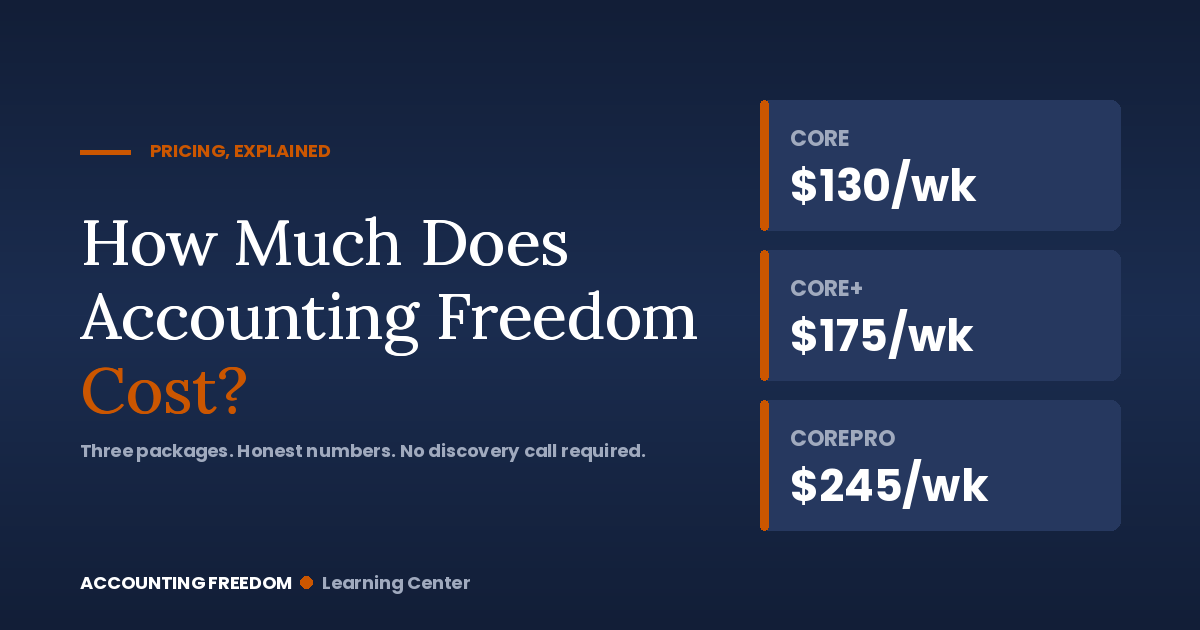
Our three small business CPA packages start at the following weekly rates:
- Core — starts at $130/week
- Core+ — starts at $175/week
- CorePro — starts at $245/week
Those are starting points, not flat rates. Your actual monthly accounting cost depends on transaction volume, number of bank accounts, payroll headcount, and how clean your existing books are. We’ll get into the specifics of each package below — but if you’re just here to see whether you can afford to talk to us, those numbers are the answer.
A note on what those numbers don’t include: each new client engagement starts with a one-time onboarding fee that’s typically equal to three months of your accounting fee. That covers chart of accounts review, software setup, document migration, reviewing prior tax returns, and reviewing first month financial statement. It does not include getting your books to a clean starting point. If we are preparing any prior months or tax returns, that would be an additional fee based on the amount of months required — we’ll tell you up front, in writing, before you commit.
Why CPA pricing varies (and why ours does too)
Three things drive the price you’ll pay any small business accountant, including us:
- Transaction volume. A landscaper with 40 transactions a month and a restaurant with 800 transactions a month can’t pay the same price. The bookkeeping work isn’t the same.
- Complexity. Multiple entities, payroll across states, inventory tracking, complicated owner compensation structures — each one adds time. A simple S-corp with one bank account is cheaper to serve than a multi-location LLC with 15 employees.
- Cleanup work. If we take over books that are six months behind, we have to catch them up before we can run them forward. That’s billed separately as backwork, not folded into the weekly rate.
Most accounting firms structure their pricing differently because they’re solving for these three variables in different ways. Patrick Accounting in Memphis publishes similar tier pricing — their entry tier starts around $175/week. CSI Accounting & Payroll runs comparable monthly accounting cost tiers. The underlying small business cpa cost math is roughly the same across the industry. The packages just bundle the work differently.
Core: clean books and tax prep, starting at $130/week
The Core package fits small businesses doing roughly $250K to $1M in revenue who need their books done right and their taxes filed without surprises. If you’ve been doing your own QuickBooks at the kitchen table on Sunday nights, this is usually the level you’re outgrowing into.
What you get at $130/week:
- Monthly bookkeeping with reconciled bank and credit card accounts
- Monthly financial statements (P&L, balance sheet, cash flow)
- Annual business tax return (federal and state)
- Annual personal return for the business owner
- Year-end 1099 prep and filing
Core does not include monthly advisory meetings, tax planning, or fractional CFO work. If you want those, you’ll want Core+ or CorePro.
Core+: monthly advisory and proactive tax planning, starting at $175/week
The Core+ package fits small businesses doing $500K to $10M who need a professional who’s actually engaged in the business — not just filing returns once a year. This is where most of our growing contractor, restaurant, and insurance agency clients land.
Everything in Core, plus:
- Monthly advisory meetings with your Client Advisor
- Year-round tax planning (not just year-end)
- Quarterly tax projections and estimated payment guidance
- Owner compensation strategy review (S-corp reasonable comp, distributions)
- Entity structure review and recommendations
At this tier, the Accounting Freedom cost difference vs. Core is mostly about access — you get monthly time with your Client Advisor instead of quarterly. This is the level where most owners stop dreading tax season. Once your Client Advisor is in your books every month and looking forward instead of backward, April becomes a non-event.
CorePro: Advanced Financial Insights starting at $245/week
The CorePro package fits small businesses doing $5M to $15M who need CFO-level information but don’t want to hire one full-time. CFOs in our market run $180K to $250K all-in. CorePro gets you the strategic work for a fraction of that.
Everything in Core+, plus:
- Budget vs. actual report
- Cash flow forecasting and modeling
- Business Audit Protection for Income Tax Returns
- Custom KPI dashboard
- Annual business performance review
At $245/week, the Accounting Freedom cost for CorePro is roughly 60-70% less than hiring an in-house CFO. CorePro is for owners who’ve stopped looking at their financials as a compliance task and started using them as a steering wheel. If you’re growing fast, considering an acquisition, or planning an exit in the next five years, this is usually the right level.
Which package is right for your business?
Here’s a rough decision framework. It’s not perfect — we’ll always recommend a discovery call to confirm — but it gets most owners 80 percent of the way there.
- Pick Core if your revenue is aroudn $500k, your books are mostly fine, and you want compliance only work done right.
- Pick Core+ if you’re between $500K and $10M, you want proactive tax planning, and you’re tired of finding out about tax bills in March.
- Pick CorePro if you’re $10M+ and you need strategic financial leadership without the cost of hiring a full-time CFO.
Still not sure? Use our pricing calculator on the /pricing page to get a more specific estimate based on your transaction volume and complexity. It takes about three minutes and gives you a real number — no email required.
What we don’t do (and where we’re not the right fit)
Honest answer: we’re not the right accounting firm for everyone. Here’s where Accounting Freedom isn’t a fit:
- Solopreneurs under $250K. The math just doesn’t work — you’ll pay less for an Intuit Live or QuickBooks Live setup until you grow.
- One-time tax prep with no ongoing relationship. We don’t do drop-and-go returns. Every client engagement includes the bookkeeping that the return is built on.
- Owners who want to stay arms-length from their numbers. Our process assumes monthly engagement. If you don’t like returning phone calls or emails and are not fully invested in our relationship, we’ll frustrate each other.
If any of those describe you, we’re happy to point you toward a better fit. We’d rather lose a sale than start a relationship we can’t serve well.
Honest questions to ask any accounting firm — including us
If you’re comparing accounting firm packages from us against another firm, here are the questions that actually surface the differences. Most discovery calls don’t get this specific. They should.
- What’s the total Accounting Freedom cost — or anyone else’s cost — including onboarding, year-end, and any add-ons? The published rate is usually just the starting point.
- Who actually does the work? Is it the partner you met on the call, or someone you’ll never see again?
- How many other clients does the team handle? More than 75 per accountant usually means service quality slips.
- What happens when something goes wrong? Late filing, missed deduction, IRS notice — what’s the firm’s process for owning a mistake?
- Can I see a sample monthly financial package? If they can’t show you what you’ll actually receive each month, that’s a flag.
These questions cut through the sales-call polish and tell you what working with the firm will actually feel like. They work on us, too — and we’d rather you ask them now than find out the answers six months in.
What to do next
Three options, depending on where you are:
- Get a more specific number. Use the pricing calculator on our /pricing page to get an estimate of what your business would actually cost based on volume and complexity. No email required.
- Schedule a discovery call. We do a 30-minute conversation about your business, your books, and what you’re trying to accomplish. No prep work needed on your end. You can book directly on our /schedule page.
- Read more first. If you want to understand the broader picture before talking to anyone, our small business CPA cost comparison guide and our CPA-vs-bookkeeper comparison go deeper into how to evaluate any accounting firm — including ones that aren’t us.
Whatever you decide — even if it’s not us — we’re rooting for you. Running a small business in Lake County or Milwaukee or anywhere else in our footprint is hard. The right accounting firm should make it less hard. That’s the whole job.
Related reading on this site: When an Accounting Firm Isn’t the Right Fit • What to Look for When Hiring an Accounting Firm for Your Small Business • Why Small Business Owners Always Get a Surprise Tax Bill — and How to Fix It