

Hiring an In-House Controller vs. Hiring Us: When Each One Wins
Hiring an In-House Controller vs. Hiring Us: When Each One Wins
A small business owner asked us a question we don’t get very often: should they stop paying us and hire their own controller instead. Most owners never ask it — they just assume more revenue means it’s automatically time to bring finance in-house. It isn’t, always.
When does hiring an in-house controller make more sense than an outsourced accounting firm?
Most businesses cross into serious in-house-controller territory somewhere between $10 million and $15 million in revenue — and only once someone needs to be making financial decisions every day, not reviewing them once a month. Below that range, an outsourced firm typically costs less and covers more ground. Above it, especially with real operational complexity, a full-time controller often earns their salary.
That’s the short answer. Here’s the math and the reasoning behind it.
What does an in-house controller actually cost?
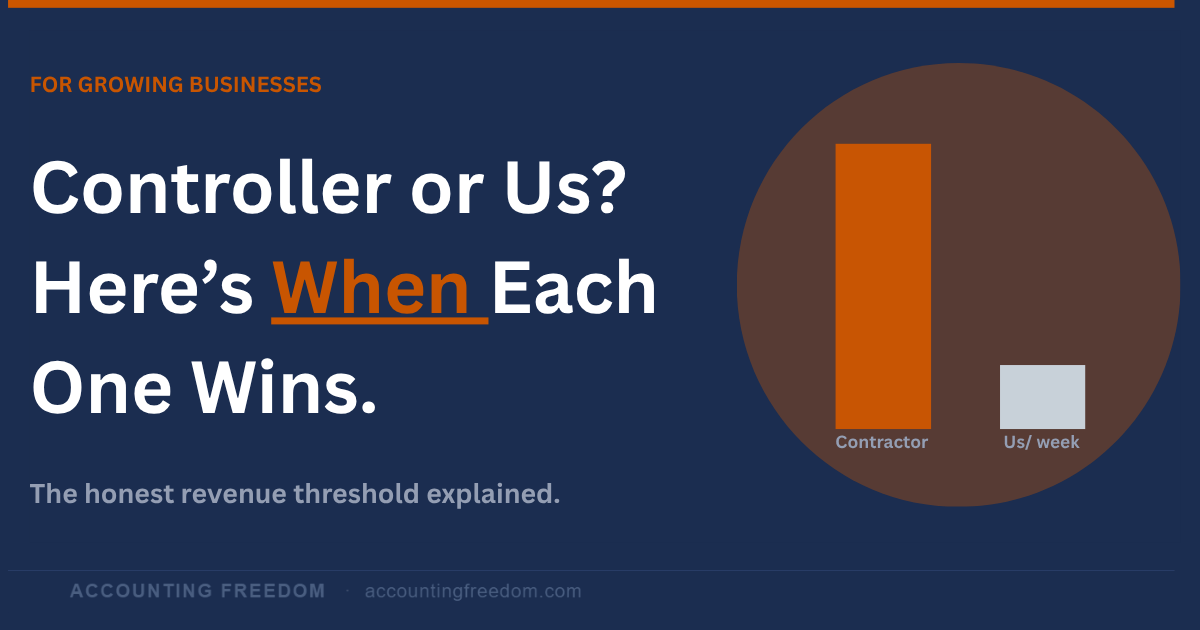
The Bureau of Labor Statistics tracks controllers under its “financial managers” category. As of May 2025, the median annual wage for financial managers nationally was $166,570 — before benefits, payroll taxes, PTO, or any bonus structure most companies add to keep a good one.
Compare that to our CorePro tier starting at $245/week — a fixed, predictable cost with no severance risk, no benefits administration, and no single point of failure if that person takes vacation or leaves.
What do you get from an outsourced firm that one controller can’t replicate?
- Bench depth. If your controller is out sick, on leave, or leaves the company, you aren’t left without financial leadership — our whole team steps in.
- Broader expertise. One controller has one career’s worth of experience. Our firm brings tax, systems, and multi-industry pattern recognition across dozens of clients.
- No turnover risk. You don’t re-run a six-month hiring search when a controller leaves — we don’t quit on you.
- A fixed, predictable weekly cost instead of a salary, benefits package, and payroll tax line that grows every year.
So what’s the honest threshold?
It comes down to three questions, not a revenue number alone:
- Does someone need to make real-time financial calls every single day — not review numbers on a monthly cadence?
- Is the business complex enough — multiple entities, multiple states, inventory, multiple revenue streams — that outside advisory can’t keep pace?
- Can the business absorb $166,570 in loaded cost and get more value out of it than our CorePro engagement?
Under $10 million, very few businesses clear that bar. Above $15 million, especially with real growth complexity, many do. And the businesses in between often do best with a hybrid: a controller who handles daily operations, working alongside us for tax strategy, systems, and the advisory work a single hire rarely has bandwidth for.
In-house controller vs. Accounting Freedom — the side-by-side
| Factor | In-House Controller | Accounting Freedom (CorePro) |
| Annual cost | ~$166,570 | $245/week (~$12,740/year) |
| Availability | Full-time, on-site | Weekly/monthly cadence + on-call |
| Expertise breadth | One person’s career experience | Whole-firm bench across tax, systems, advisory |
| Backup coverage | None built in — vacation and turnover risk | Team coverage, no single point of failure |
| Best fit | $10M–$15M+ with daily decision-making needs | Up to ~$10M–$15M, or paired with a controller above that |
What this means for you
- Under $10 million in revenue: the math almost always favors staying with an outsourced firm.
- $10 million–$15 million and growing fast: worth a conversation, not necessarily a switch.
- Above $15 million with real day-to-day complexity: an in-house controller paired with outsourced tax and advisory support is often the strongest setup — and we’ll tell you that ourselves.
Not sure which side of the line you’re on?
Take our Which Package Is Right for You quiz, or grab time on the calendar and we’ll walk through your actual numbers — including whether a controller conversation makes sense for you yet.
Frequently asked questions
Yes. Many growing businesses keep both — a controller for daily decisions, and our team for tax strategy, systems, and the advisory work one hire rarely has time for.
No single number applies to every business. Most owners we’ve talked with feel the pull somewhere between $10 million and $15 million, especially once operations get more complex.
Rarely on its own. Controllers still typically need outside tax expertise, which is why so many keep a firm like ours in the picture even after they bring finance in-house.
This article is provided for general informational purposes only and does not constitute tax, legal, accounting, or financial advice. Every business situation is different. Before acting on anything you read here, please consult with a qualified advisor — including, we hope, us. Reach out to Accounting Freedom for guidance specific to your situation.
Frank Fiore, CPA is the President of Accounting Freedom and Payroll Freedom, serving small businesses across Illinois and Wisconsin for more than 20 years. He’s spent much of that career helping owners figure out exactly when to bring finance in-house — and when not to.