

LLC vs. S-Corp: What’s the Difference, and Should Your LLC Elect S-Corp Status?
If you’ve ever asked your accountant, “Should I be an LLC or an S-Corp?” — you’re not alone. We get this question almost every week.
Here’s the truth: it’s the wrong question. Not because it doesn’t matter — it matters a lot — but because an LLC and an S-Corporation aren’t the same kind of thing. Comparing them is like asking, “Should I drive a Ford or an automatic?” One is a vehicle. The other is a transmission. You need to pick both.
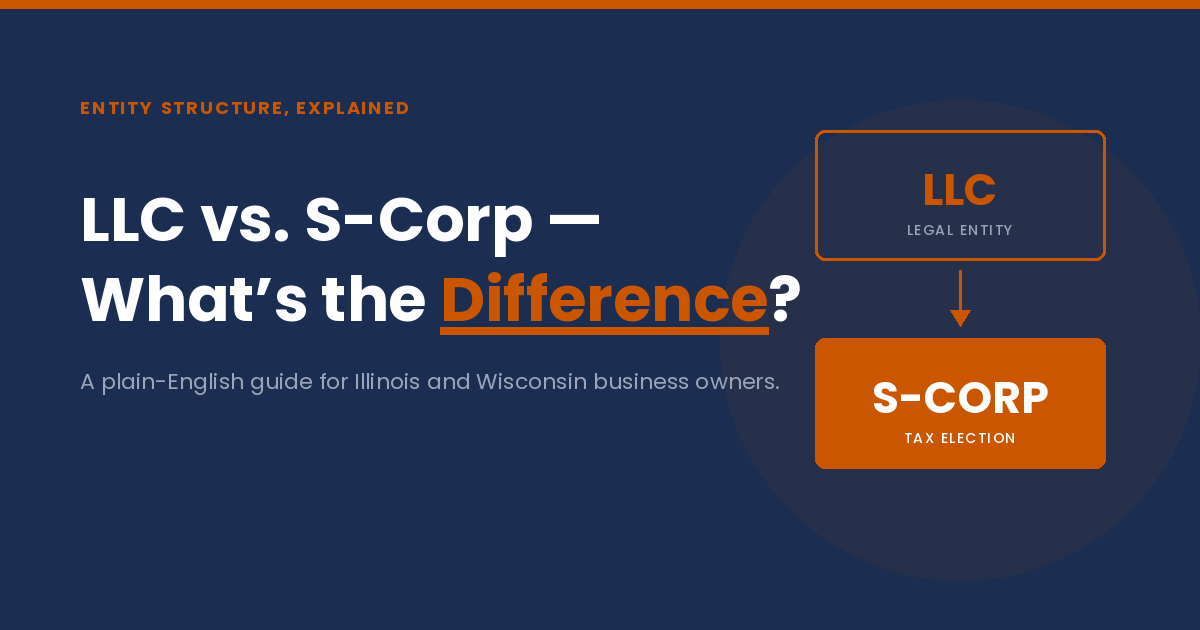
In plain English: an LLC is a legal entity. An S-Corporation is a tax election. Once you understand that, the rest of this gets a lot easier.
This post walks through what each one actually is, how they interact, when electing S-Corp status saves you real money, what it costs you to make the switch, and how Illinois and Wisconsin treat the two differently — because they do, and it matters.
The Short Answer
An LLC is the legal structure you form with your state to separate your personal assets from your business. An S-Corporation is a tax classification you elect with the IRS to change how your business income is taxed — specifically, to reduce self-employment tax. An LLC can choose to be taxed as a sole proprietorship (the default for a single owner), a partnership (the default for multiple owners), a C-Corporation (think large companies) or an S-Corporation. The S-Corp election is what most established small business owners eventually consider, because at the right income level, it can save $10,000 or more per year in taxes.
What Is an LLC?
A Limited Liability Company is a legal entity created at the state level. You form an LLC by filing articles of organization with the Illinois Secretary of State or the Wisconsin Department of Financial Institutions. Once you do, your business becomes a legal “person” — separate from you.
What that gets you:
- Liability protection. If the business gets sued, your personal assets (home, savings, retirement) are generally protected.
- Flexibility. You can have one owner or many. You can be member-managed or manager-managed. You decide most of the rules.
- Default tax treatment. A single-member LLC is taxed as a sole proprietorship. A multi-member LLC is taxed as a partnership. Both are “pass-through” — the business doesn’t pay income tax; the profits flow to your personal return.
An LLC, by itself, doesn’t change your taxes much. That’s the part most owners miss.
What Is an S-Corporation?
An S-Corporation is not a business entity. It’s a tax election. You don’t “form” an S-Corp the way you form an LLC. You form a legal entity first — usually an LLC, sometimes a corporation — and then file IRS Form 2553 to ask the IRS to tax that entity as an S-Corporation.
What the S-Corp election changes:
- How the owner gets paid. Instead of taking all profits as self-employment income, the owner takes part as a W-2 salary and part as a distribution.
- What’s subject to payroll tax. The W-2 salary portion is subject to Social Security and Medicare taxes (15.3% combined) plus federal and state unemployment taxes. The distribution portion isn’t.
That second point is the entire reason people elect S-Corp status. It’s where the savings come from.
How an LLC Can Be Taxed as an S-Corporation
Here’s how it actually works in practice. You form an LLC with your state. The LLC is your legal entity — it exists, it owns the business, it provides liability protection. Then you file Form 2553 with the IRS, electing for that LLC to be taxed as an S-Corporation.
The LLC doesn’t change. It’s still an LLC on paper. But the IRS now taxes it under Subchapter S of the tax code, which means:
- The LLC files an 1120-S corporate return each year (instead of reporting on your Schedule C).
- You become an employee of your own LLC.
- The LLC must run payroll for you.
- You pay yourself a “reasonable salary” (more on that below).
- Profits above your salary come to you as distributions, free of self-employment tax.
This is the move. This is what saves the money.
When the S-Corp Election Actually Saves Money
Here’s where it matters. If you’re a sole proprietor or single-member LLC making $80,000 in net profit, all $80,000 is subject to self-employment tax (15.3%) — about $12,240. Painful, but the math doesn’t yet justify the cost of an S-Corp election.
Now move that number up. Say you’re netting $150,000. As a sole prop, your self-employment tax bill is roughly $22,950. As an S-Corp with a reasonable salary of $75,000? You’d pay payroll tax on the $75,000 (about $11,475) and the remaining $75,000 comes through as a distribution with no self-employment tax. Savings: around $11,000 per year.
We’ve had clients save $10,000+ per year by making this election. Insurance agents are a classic example. They almost always start as sole proprietors, their commission income builds up, and they’re paying enormous self-employment tax bills they don’t have to. The first time we run the numbers with an insurance agent client, the reaction is usually the same: “Why didn’t anyone tell me this sooner?”
For most small business owners, the S-Corp election starts to make sense somewhere between $60,000 and $80,000 in net profit — but the right answer depends on your industry, your reasonable salary, and your state. We run the math for clients in our tax planning service before recommending the election.
The Downsides Nobody Talks About
Here’s what most “S-Corp will save you taxes!” articles leave out: it’s not free.
1. You have to run payroll. Once you’re an S-Corp, you’re an employee. You need a real payroll system, with W-2 reporting, quarterly 941s, year-end W-2s, and state unemployment filings. That’s an annual cost — typically $1,000–$2,500 depending on the provider. (For what it’s worth, that’s what our sister brand, Payroll Freedom, exists to handle.)
2. The 1120-S return is more expensive than a Schedule C. Expect to pay $1,500–$3,000 more per year in tax prep than you would as a sole proprietor.
3. Reasonable compensation is real, and the IRS is watching. This is the biggest one. The IRS requires S-Corp owner-employees to pay themselves a reasonable salary for the work they actually do. If you try to game it by paying yourself $20,000 in salary and taking $200,000 in distributions, the IRS will reclassify those distributions as wages, hit you with back payroll taxes, and add penalties and interest. The IRS publishes specific factors for determining reasonable compensation on its S Corporation Compensation and Medical Insurance Issues page.
4. State-level taxes can claw back some of the savings. Especially in Illinois. More on that next.
5. You can’t easily un-do it. Once you elect S-Corp status, switching back has timing rules and limitations. Don’t elect it casually.
How Illinois and Wisconsin Treat This Differently
This is where being a local firm matters. Illinois and Wisconsin handle S-Corps differently, and the difference can change the math.
Illinois: The Replacement Tax Catch
A single-member LLC taxed as a sole proprietorship pays no Illinois entity-level tax — the income just flows to your personal return at the flat 4.95% rate.
The moment that same LLC elects S-Corp status, it becomes subject to Illinois’ 1.5% Personal Property Replacement Tax (PPRT) on net income. That’s an entity-level tax that didn’t exist before the election.
For a business netting $150,000, that’s an extra $2,250 a year that wasn’t there before. It doesn’t kill the S-Corp election — federal savings still usually win — but it shrinks the spread, and it’s something most generic articles ignore.
Wisconsin: Cleaner, Mostly
Wisconsin recognizes the federal S-Corp election and doesn’t impose a replacement tax at the entity level. S-Corp income flows to the shareholder’s personal return at Wisconsin’s individual rates. There’s an unusual “opt-out” rule that lets a federal S-Corp elect to be taxed as a C-Corp in Wisconsin — almost no one does this, but it exists.
The practical takeaway: an S-Corp election in Wisconsin is generally more tax-efficient at the state level than the same election in Illinois.
What This Means If You Operate in Both
We have clients with operations in both states. The S-Corp math has to be run with both states’ rules in mind — including apportionment, nonresident shareholder withholding, and the optional pass-through entity tax (PTET) elections each state offers. This is exactly the kind of thing that benefits from working with a firm that practices in both states.
What This Means for You
Here’s the practical takeaway:
- If you don’t have an LLC yet — start there. Form the LLC first. It’s the foundation.
- If you have an LLC and you’re netting less than $50,000, don’t worry about the S-Corp election yet. It probably doesn’t pencil.
- If you’re netting $60,000 to $80,000 or more, it’s worth running the math. The savings can be real — $5,000 to $15,000+ per year for many of our clients.
- Insurance agents, real estate agents, consultants, and other high-margin solo operators — pay closest attention. You’re the profile that benefits most.
- Don’t elect S-Corp status without modeling the full picture: federal savings, state replacement tax (in Illinois), payroll cost, additional return prep, and your reasonable salary.
This isn’t a DIY decision. The math is straightforward, but the moving pieces (state tax, reasonable comp, payroll setup, timing of the election) need someone who’s done it before.
Ready to Find Out If S-Corp Status Makes Sense for You?
If you’re an Illinois or Wisconsin business owner wondering whether you’re leaving money on the table, the first step is a conversation. We run the numbers for you — federal, state, payroll cost, the works — and tell you straight whether the election makes sense this year, next year, or not at all.
Use our pricing calculator to see what working with us looks like, or schedule a quick conversation and we’ll walk through your situation.
Disclaimer: This article is provided for general informational purposes only and does not constitute tax, legal, accounting, or financial advice. Every business situation is different. Before acting on anything you read here, please consult with a qualified advisor — including, we hope, us. Reach out to Accounting Freedom for guidance specific to your situation.
Frank Fiore, CPA is the President and Visionary at Accounting Freedom in Mundelein, Illinois. A CPA with over 20 years of experience advising Illinois and Wisconsin small business owners, Frank specializes in proactive tax planning, entity structure, and helping growing businesses move from compliance work to advisory relationships. Frank leads a team of Client Advisors and Enrolled Agents across two offices serving businesses from $500K to $15M in revenue.