

Why Your Business Is Profitable But Always Short on Cash
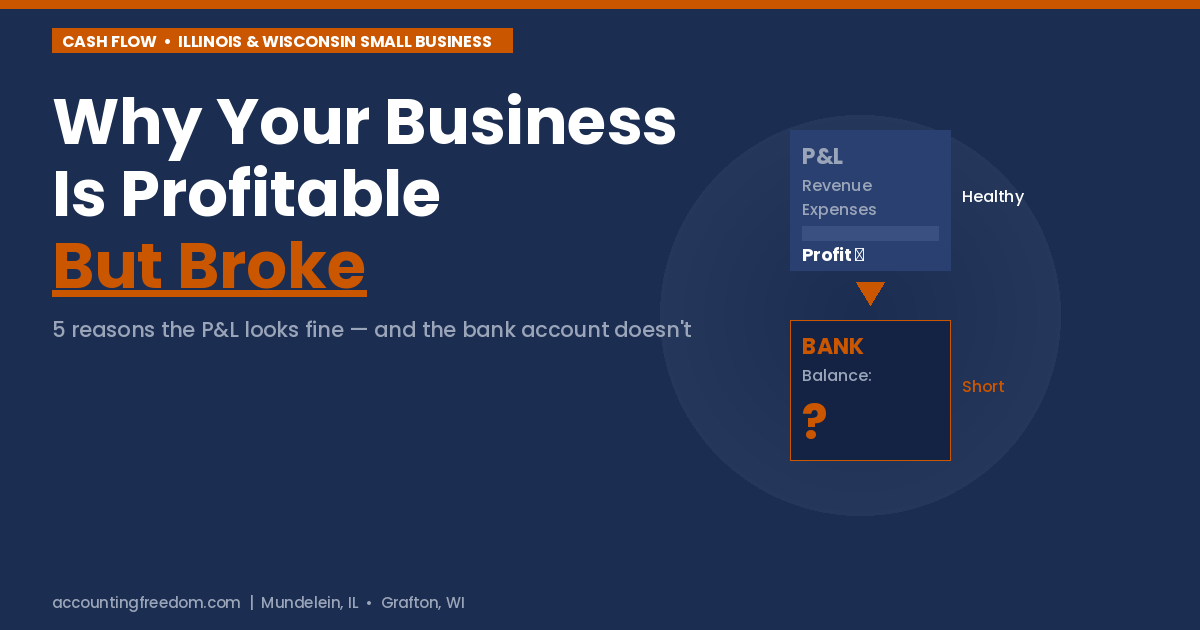
Your P&L says you made money last month. Your bank account disagrees. If you’re running a profitable business short on cash, you’re not doing something wrong — you’re experiencing one of the most common and most misunderstood problems in small business finance.
It happens to contractors in Illinois every winter. It happens to restaurants in Wisconsin after a slow January. It happens to insurance agencies after a strong commission month that hasn’t been paid out yet. The business isn’t failing. The timing is.
Profit and cash are two different numbers. This post explains why a profitable business runs short on cash — and what to do about it.
The short answer: A profitable business short on cash is almost always a timing problem, not a performance problem. Profit is an accounting result — it shows up on your P&L when revenue is earned. Cash is what’s actually in your bank account. Several things make those numbers move in opposite directions at the same time: slow-paying customers, loan principal payments, owner draws, inventory, taxes, and growth itself.
Why a Profitable Business Is Short on Cash — 5 Common Reasons
Most small business owners learned to watch one number: profit. Revenue minus expenses. If that number is positive, the business is healthy. Right?
Not exactly. Profit tells you whether your business model works. Cash tells you whether you can make payroll on Friday. Both matter — but they measure different things, and they don’t always move together.
Here’s the core of it: your P&L records revenue when it’s earned, not when the money hits your account. It records expenses when they’re incurred, not when they’re paid. That timing gap — between when accounting says money exists and when it actually arrives — is where most cash problems live.
Reason #1: Slow Collections — the Most Common Reason a Profitable Business Runs Short on Cash
Slow collections are the most common reason profitable businesses run short on cash. The work is done. The invoice is out. The revenue is on the books. The money just isn’t here yet.
For contractors, net-30 or net-60 payment terms are standard — which means you’re financing your customers’ projects with your own cash for weeks. For medical practices, insurance reimbursements can sit in processing for 30–90 days. For manufacturers and distributors, large accounts often have long payment cycles built into the contract.
The fix starts with your accounts receivable aging report. If you’re not reviewing it every week, you’re flying blind. Growing A/R is a warning sign — it means revenue is piling up on paper while cash stays in your customers’ accounts. Contractors especially need to track this by job, not just as a total.
Reason #2: Loan Payments and Owner Draws Keep Cash Lower Than Profit Suggests
This one surprises a lot of business owners the first time they hear it.
When you make a loan payment, only the interest portion shows up as an expense on your P&L. The principal repayment — the chunk of the loan balance you’re paying down — comes straight out of your cash but never appears on your income statement. Your P&L looks fine. Your bank account takes a hit you didn’t see coming.
Owner draws work the same way. Taking $8,000 out of the business this month? That’s not an expense. It doesn’t reduce your reported profit. But it absolutely reduces your cash. A business owner who takes distributions based on what the P&L says — without accounting for upcoming payroll, vendor payments, or tax obligations — is making a common and expensive mistake.
The rule of thumb: never make owner distribution decisions based on your P&L alone. Base them on your cash flow forecast — what’s coming in and what’s going out over the next 60–90 days.
Reason #3: Quarterly Tax Bills Hit a Profitable Business Short on Cash All at Once
Your P&L spreads your tax liability across the year as income accumulates. Your actual tax payments don’t work that way. Estimated quarterly taxes come due in April, June, September, and January — and if Q1 happens to be your slowest quarter but a big payment is due in April, the timing alone can create a real shortage.
Illinois and Wisconsin small business owners owe both federal and state estimated taxes on top of that. Illinois has specific deadlines for pass-through entity tax payments that operate on their own schedule — separate from your federal estimated payments — and they catch business owners off guard every year. If your accountant isn’t helping you set aside reserves month by month for both, you’ll feel it when the due date arrives.
The fix is simple but requires discipline: treat your estimated tax payments like a monthly expense. Set aside a percentage of every deposit — typically 25–30% for most Illinois and Wisconsin small business owners — into a separate account. Don’t wait for the quarterly due date to find the money. For a deeper look at proactive tax planning, see our post on year-end tax moves for Wisconsin small business owners and the reason most small business owners get surprise tax bills.
Reason #4: Growth Leaves Even a Profitable Business Short on Cash Temporarily
This one is counterintuitive. Growing businesses are often the ones most strapped for cash — not because they’re doing something wrong, but because growth demands cash upfront before the revenue from that growth arrives.
You hire two new employees in March to handle more work. Payroll runs in two weeks. The new revenue from that capacity won’t show up for 60–90 days. You buy $20,000 in equipment to take on a larger job. The cash goes out immediately. The job invoices net-45. You land your biggest customer yet — and spend the next six weeks delivering the work before you can bill them.
None of this is bad business. It’s the cash conversion cycle — the time between when you spend money to deliver your product or service and when you actually collect it. The longer that cycle, the more working capital your business needs to stay liquid while it grows.
Reason #5: Bad Visibility — You Can’t Fix a Profitable Business Short on Cash If You Can’t See It
Sometimes the gap between profit and cash isn’t a cash flow problem — it’s a visibility problem. Books that are two months behind, reconciliations that haven’t been run, invoices that were recorded but never followed up on. If your accounting isn’t current, you’re making decisions based on a financial picture that doesn’t reflect reality.
This is especially common for small businesses that use a tax-only accountant — someone who reconciles the books once a year in February, files the return, and doesn’t touch the numbers again until next year. By the time you find out there was a problem, it’s already six months old.
If you’re not sure whether your accounting setup gives you the visibility you need, our guide to signs you’ve outgrown your accountant is a useful starting point.
What to Do When Your Profitable Business Is Short on Cash
The good news: cash flow problems are almost always fixable once you understand what’s causing them. Here’s where to start.
- Pull your A/R aging report this week. How much is 30+ days overdue? What’s the trend over the last three months? Growing A/R is a warning sign that needs attention before it becomes a crisis.
- Build a 13-week cash forecast. Map out every expected inflow and outflow for the next quarter. It won’t be perfect. It will show you shortfalls before they arrive — which is the entire point.
- Set aside tax reserves monthly. Don’t wait for the quarterly estimated payment to find the money. 25–30% of net income into a separate account, every month, is a reasonable starting point for most IL/WI small business owners.
- Separate your personal draws from business cash decisions. Never take a distribution based on the P&L. Base it on what the business actually needs to cover the next 60 days.
- Get monthly books, not annual tax prep. If you’re not seeing clean monthly financials, you don’t have the visibility to manage cash proactively. That’s what the Core tier at Accounting Freedom is built to provide.
If your current accounting setup isn’t giving you this visibility, that’s worth a conversation. The pricing calculator shows what each tier covers — no email required. Or use the two-minute package assessment to see which level fits your situation.
Not sure why your numbers don’t add up?
That’s exactly the kind of conversation we have in a free consultation. No pitch — just a look at what’s happening and what would fix it.
Schedule a Free Consultation See Our PricingDisclaimer: This article is provided for general informational purposes only and does not constitute tax, legal, accounting, or financial advice. Every business situation is different. Before acting on anything you read here, please consult with a qualified advisor — including, we hope, us. Reach out to Accounting Freedom for guidance specific to your situation.
About the Author
Frank Fiore, CPA — Presidnet & Visionary, Accounting Freedom
Frank Fiore has spent 20+ years helping small business owners in Illinois and Wisconsin understand the difference between what their P&L says and what their bank account shows. Accounting Freedom serves clients from offices in Mundelein, IL and Grafton, WI.