

5 Mistakes Small Business Owners Make When Switching Accounting Firms
Switching accounting firms is one of those decisions that feels straightforward until you’re in the middle of it. You know you need a change, you find someone new, you make the call. And then, somewhere between telling your old firm and your first month with the new one, things go sideways in ways nobody warned you about.
Most small business owners switch accounting firms once or twice in the life of their business — not enough repetitions to know what the common mistakes are before making them. These five mistakes show up consistently when switching accounting firms, and most of them are entirely avoidable with a little preparation.
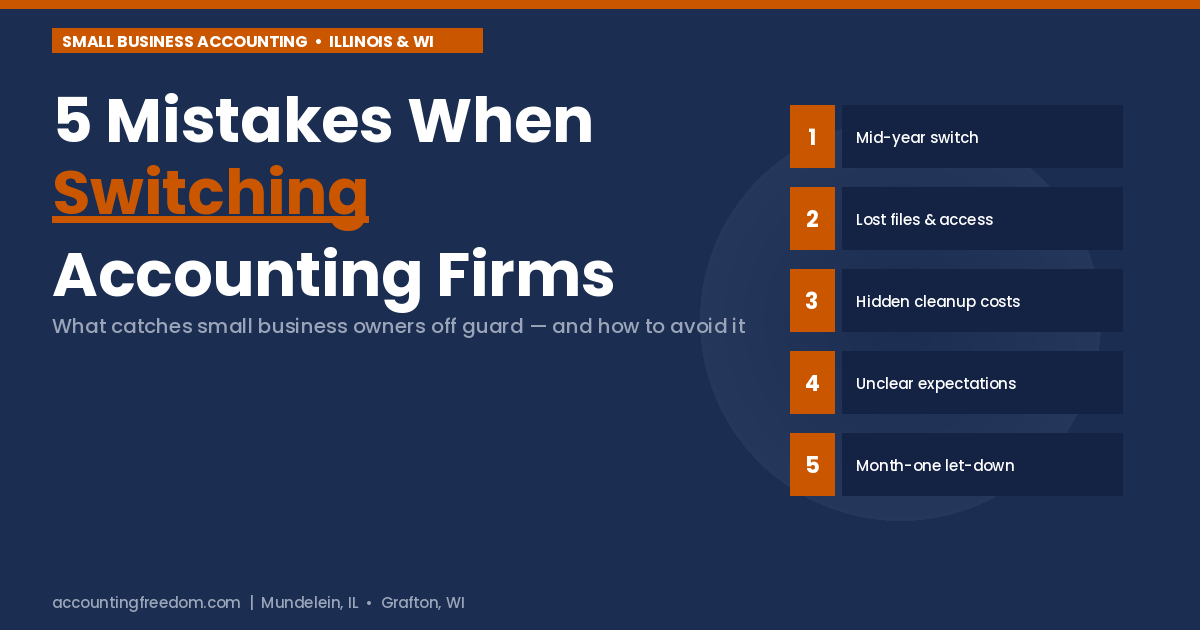
The short version: The five mistakes that catch small business owners off guard when switching accounting firms are: switching mid-year without a plan for the transition period, not getting prior-year files and access before the relationship ends, underestimating the cleanup cost when books aren’t in good shape, picking a new firm before clarifying exactly what the new relationship includes, and expecting everything to be perfect in month one. Most are avoidable. All of them are recoverable. Knowing about them in advance is the difference between a smooth transition and a stressful one.
Mistake #1: Switching Accounting Firms Mid-Year Without a Transition Plan
The most common timing mistake is making the switch in the middle of the year — usually because something goes wrong in March or April and the business owner acts immediately. That’s understandable. However, mid-year switches create a specific problem: your financial history is split between two firms, which complicates year-end tax preparation significantly.
When your books live in two different places for two different parts of the year, someone has to reconcile them — and that work costs money. Moreover, the new firm may not have the context to understand transactions from the first half of the year without documentation that your old firm holds.
The cleaner alternative: if you’re considering switching accounting firms, start the conversation now — but plan the transition for January 1. Complete the current year with your existing firm, request all your files at year-end when everything is closed out, and start fresh with your new firm on a clean slate. If the current relationship has truly broken down, that conversation with a new firm can still start today, even if the formal transition waits.
Mistake #2: Not Securing Your Files Before Switching Accounting Firms
Financial records are yours. Your tax returns are yours. Your QuickBooks file, your prior-year workpapers, your payroll records — all of it belongs to your business. But getting those records back from a departing firm is not always as simple as asking for them, and many business owners discover this only after the relationship ends.
Some firms hold files as leverage if fees are outstanding. Others move slowly out of simple disorganization. A few operate on platforms where the data technically lives in the firm’s account rather than yours. In any of these scenarios, switching accounting firms without securing access first creates a gap — sometimes a significant one.
At Accounting Freedom, our onboarding process includes a document collection step specifically designed to fill these gaps — but the process goes faster and costs less when the prior firm has been cooperative and the files are organized. The more complete the records coming in, the lower the onboarding cost on your end. You can see exactly what our onboarding covers at our What Working With Us Looks Like page.
Mistake #3: Underestimating the Cleanup Cost When Switching Accounting Firms
Here’s a conversation that happens frequently with new clients: a business owner switches accounting firms hoping for a fresh start, and the first thing the new firm finds is that the prior books need significant cleanup before any meaningful accounting can happen. The owner assumed this was just a transition. Instead, it’s an unplanned project with a real cost attached to it.
Cleanup work — reconciling prior months, correcting miscategorized transactions, rebuilding a chart of accounts — takes time and expertise. Most firms quote it separately from their ongoing accounting fee, and the cost can be meaningful depending on how far behind the books are and how many years need attention.
Cleanup costs are not the new firm’s fault, and they’re not a negotiating tactic. They reflect real work that needs doing before your books can be trusted. Asking the new firm during the evaluation process — “What do you typically find when you take on a client like me, and how do you handle cleanup?” — will get you a straight answer from any firm worth working with.
For context on what Accounting Freedom’s onboarding fee covers — and what it doesn’t — see our pricing page. Cleanup of prior periods, if needed, is quoted separately and disclosed upfront in writing before any work begins.
Mistake #4: Picking a New Firm Before Clarifying What Switching Accounting Firms Actually Gets You
Not all accounting firms are the same — and not all “accounting” engagements include the same things. One of the most common sources of disappointment after switching accounting firms is discovering that the new firm does things differently than expected, because the expectations were never spelled out.
Some firms provide monthly financial statements as a standard deliverable. Others only reconcile books quarterly. Some include a tax planning call before year-end. Others file the return and send you a bill. Some assign a named advisor who knows your business. Others route everything through a general support inbox. These are all legitimate models — but if you don’t know which model you’re buying, the switch can feel like more of the same.
Before committing to a new firm, get specific answers to these questions:
Questions to Ask Any Firm Before Switching
- How often will I receive financial statements, and by what date each month?
- Who specifically will be handling my account, and how do I reach them?
- Does tax planning happen before year-end, or after?
- What triggers a call from you — or do I always have to initiate?
- What’s included in the weekly fee, and what gets billed additionally?
Expecting Everything to Be Perfect in Month One
Switching accounting firms is a relationship transition, not a software installation. Even under ideal circumstances — good records coming in, clean books, cooperative prior firm — month one with a new firm takes longer than subsequent months. There’s a learning curve on both sides.
Your new firm needs time to understand your business: your revenue mix, your seasonal patterns, your key vendors, your owner compensation structure. Some of that comes through onboarding documentation. Most of it comes through the first few months of working together. Expecting the first monthly financial statement to look exactly right, or the first tax planning call to cover every nuance, sets up an unfair comparison.
Most business owners feel fully settled with a new accounting firm after 90 days. Month one involves setup and data migration. By month two, the first full monthly cycle and financial review is complete. Month three is when the real rhythm establishes and the advisor has enough context to start adding value.
How to Switch Accounting Firms Without the Headaches
Most of these mistakes come down to timing and preparation. The AICPA notes that client record transitions go smoothest when both parties document the handoff in writing. Here’s a simple checklist for switching accounting firms the right way.
Before You Leave Your Current Firm
- Request admin access to your accounting software account — confirm it’s in your name, not the firm’s
- Download the last three years of signed tax returns
- Request your current-year financials through the transition date
- Identify any outstanding work in progress (open tax notices, extensions, payroll filings)
- Confirm your payroll records are complete and accessible
Before You Commit to a New Firm
- Ask specifically what’s included in the fee and what costs extra
- Confirm who your named advisor will be and how you reach them
- Ask about their onboarding process and typical timeline
- Ask directly: “What do you typically find when you take on a client like me?”
- Understand their position on cleanup fees — a transparent firm tells you upfront
Timing
- Ideal: transition at January 1 for a clean year-end break
- Acceptable: transition after a quarter close with complete records in hand
- Avoid: mid-year switches without a documented handoff plan
Switching accounting firms is worth doing when the current relationship isn’t working. The five mistakes above don’t mean you should stay somewhere that’s not serving your business. They mean the switch is worth doing carefully, with a plan, rather than reactively in the heat of the moment.
If you’re evaluating a switch and want to understand what working with Accounting Freedom looks like from day one, the best starting points are our pricing calculator and our client experience page — both designed to answer the questions you should be asking before committing to any firm.
Thinking about making a switch?
Start with a free consultation. We’ll tell you what we see, what the transition would look like, and what it would cost — before you commit to anything.
Schedule a Free Consultation See Our PricingDisclaimer: This article is provided for general informational purposes only and does not constitute tax, legal, accounting, or financial advice. Every business situation is different. Before acting on anything you read here, please consult with a qualified advisor — including, we hope, us. Reach out to Accounting Freedom for guidance specific to your situation.
About the Author
Frank Fiore, CPA — President & Visionary, Accounting Freedom
Frank Fiore has spent 20+ years on both sides of the accounting firm transition — helping clients leave firms that weren’t serving them, and building the kind of onboarding process that makes the switch worth making. Accounting Freedom serves clients from offices in Mundelein, IL and Grafton, WI.