

SEP-IRA vs. Solo 401(k) vs. SIMPLE IRA: Which Retirement Plan Fits Your Business?
This retirement plan comparison covers one of the highest-leverage tax decisions a small business owner makes — and one of the most commonly gotten wrong. Choosing between a SEP-IRA, a Solo 401(k), and a SIMPLE IRA means picking the plan that fits your income, your employee situation, and your appetite for paperwork. Pick the wrong one, and you either leave real money on the table every year or take on administrative complexity you didn’t need.
All three plans let you shelter significant income from taxes. The right one depends on your income level, whether you have employees, and how much administrative simplicity you’re willing to trade for a bigger contribution. Here’s how the three compare for 2026, with real numbers.
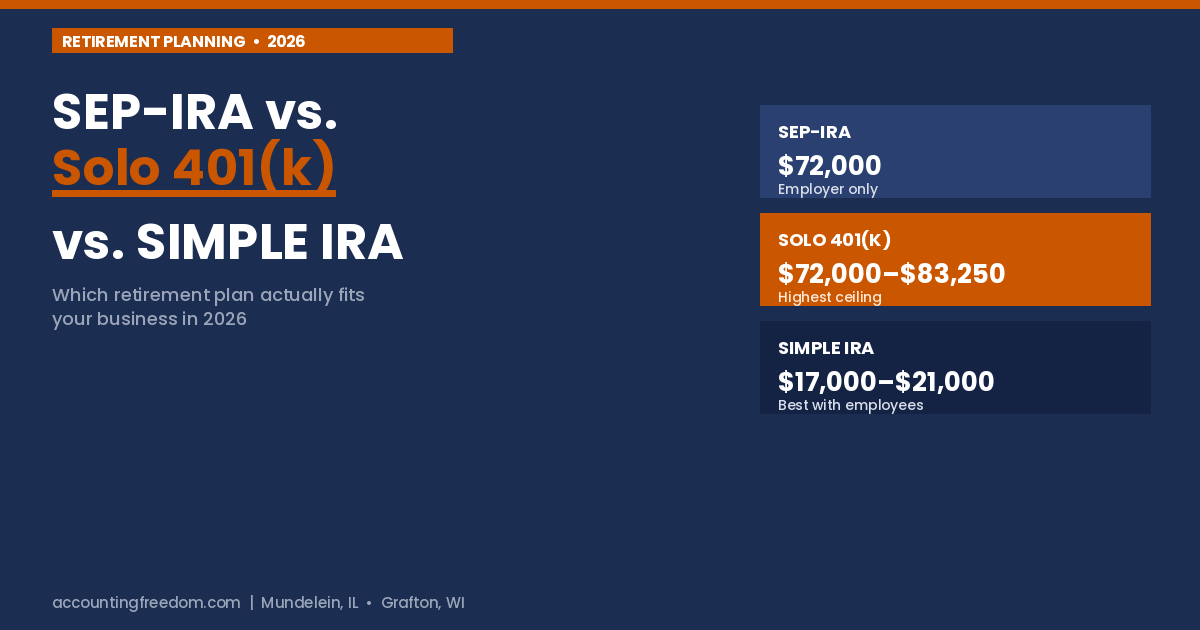
Bottom line up front: This retirement plan comparison boils down to income, employees, and timing. For most self-employed individuals and owner-only businesses earning above roughly $60,000, the Solo 401(k) allows the largest contribution — up to $72,000 in 2026 ($80,000 with catch-up at 50+), because it combines an employee deferral with an employer contribution. The SEP-IRA is the simplest to set up and offers the most flexible deadline, but employer-only contributions cap it at the same $72,000 ceiling without the extra deferral room. The SIMPLE IRA has the lowest contribution ceiling ($17,000 for 2026, $21,000 with catch-up) but is often the right fit once you have employees, since it comes with lower mandatory employer contributions than a SEP.
Factors That Drive This Retirement Plan Comparison
Before comparing the plans directly, it helps to know which factors actually drive the decision.
- Do you have employees? A SEP-IRA requires you to contribute the same percentage of compensation for every eligible employee that you contribute for yourself — which gets expensive fast once you have staff. A Solo 401(k) is only available if you have no employees other than a spouse. A SIMPLE IRA is built to work with employees from the start.
- How much do you want to contribute? Income level changes which plan lets you save the most. Below roughly $60,000 in net income, the differences are minor. Above $150,000, the Solo 401(k)’s extra employee deferral component starts to matter significantly.
- How much administrative work do you want? A SEP-IRA is a single form with no annual filing until plan assets exceed $250,000. A Solo 401(k) requires more recordkeeping and an annual Form 5500-EZ once assets cross that same threshold. A SIMPLE IRA requires an annual notice to employees and a plan document, but no complex nondiscrimination testing.
- When do you need to decide? Deadlines vary significantly by plan — covered in each section below — and missing one can eliminate that plan as an option for the current tax year entirely.
1. SEP-IRA
Simplest to Set UpA SEP-IRA is funded entirely through employer contributions — there’s no employee deferral component at all, even if you’re both the employer and the employee in your own business. For 2026, the contribution cap is the lesser of 25% of compensation or $72,000. For self-employed individuals, that calculation is more nuanced than simply applying 25% to net income, since it accounts for the deduction for half of self-employment tax.
✓ Strengths
- Simplest plan to establish and maintain
- No annual filing until assets exceed $250,000
- Can be established as late as your tax filing deadline, including extensions — the most flexible timing of the three
- Contribution percentage can change year to year, or be skipped entirely in a lean year
✗ Watch Out For
- No catch-up contributions at any age
- No employee deferral — caps out lower than a Solo 401(k) at the same income level
- No Roth option in most cases (SECURE 2.0 authorized Roth SEP contributions, but few custodians support it yet)
- If you have eligible employees, you must contribute the same percentage for them that you contribute for yourself
2. Solo 401(k)
Highest Contribution CeilingA Solo 401(k) — sometimes called a one-participant 401(k) — is available to self-employed individuals and owner-only businesses with no employees other than a spouse. It allows two layers of contribution: an employee elective deferral of up to $24,500 in 2026, plus an employer profit-sharing contribution of up to 25% of compensation, subject to a combined $72,000 cap ($80,000 with the standard catch-up at age 50+, or $83,250 for ages 60–63 under SECURE 2.0’s higher catch-up provision).
✓ Strengths
- Highest contribution ceiling of the three at most income levels
- Roth contribution option available for both the employee deferral and employer contribution
- Loan provisions available — can borrow against the plan up to $50,000 in many cases
- The employee deferral isn’t limited by the 25%-of-compensation rule, which is what creates the higher ceiling
✗ Watch Out For
- Only available if you have no employees other than a spouse
- Must be established by December 31 of the tax year for the employee deferral to count for that year
- More recordkeeping than a SEP-IRA, including a required Form 5500-EZ once assets exceed $250,000
- Under a new SECURE 2.0 rule effective January 1, 2026, catch-up contributions for anyone 50+ who earned over $150,000 in FICA wages the prior year must go into a Roth account rather than pre-tax
3. SIMPLE IRA
Best Fit With EmployeesA SIMPLE IRA is designed for businesses with up to 100 employees that don’t already sponsor another retirement plan. Employees can defer up to $17,000 of their own compensation in 2026 ($21,000 with the age-50+ catch-up), and the employer must either match employee contributions up to 3% of compensation or contribute a flat 2% of compensation for every eligible employee, regardless of whether that employee contributes anything themselves.
✓ Strengths
- Built to work with employees from day one — no complicated nondiscrimination testing
- Lower mandatory employer contribution than a SEP-IRA (3% match or 2% flat, versus SEP’s requirement to match your own percentage for every employee)
- Simple to set up — a plan document (IRS Form 5304-SIMPLE or 5305-SIMPLE) and individual accounts at a financial institution
- Employee eligibility can be limited to those earning at least $5,000 in the current year and in at least two prior years
✗ Watch Out For
- Lowest contribution ceiling of the three plans by a wide margin
- You cannot maintain a SIMPLE IRA alongside another retirement plan in most cases
- Earlier setup deadline than a SEP-IRA — waiting until year-end typically isn’t an option for an existing business
- No Roth option
SEP-IRA vs. Solo 401(k) vs. SIMPLE IRA: The Full Retirement Plan Comparison
| Factor | SEP-IRA | Solo 401(k) | SIMPLE IRA |
|---|---|---|---|
| 2026 contribution limit | Lesser of 25% of comp or $72,000 | $72,000 ($80,000 at 50+) | $17,000 ($21,000 at 50+) |
| Catch-up contributions | Not permitted | $8,000 ($11,250 for ages 60–63) | $4,000 |
| Who can contribute | Employer only | Employee deferral + employer | Employee deferral + mandatory employer match |
| Employees allowed? | Yes — but must match their % | No (except a spouse) | Yes — built for it |
| Roth option | Rare — few custodians support it | Yes | No |
| Setup deadline | Tax filing deadline + extensions | Dec. 31 for employee deferral | Generally Oct. 1 |
| Administrative complexity | Lowest | Moderate | Low |
The S-Corp Advantage Worth Knowing About
If your business is structured as an S-corp, running retirement contributions through payroll creates an additional benefit beyond the plans themselves. Employer contributions to any of these three plans are deductible as a business expense, and — because they’re employer contributions rather than wages — they don’t increase the FICA-taxable wage base the way a comparable salary increase would.
This connects directly to the reasonable compensation question S-corp and C-corp owners already have to navigate. If you haven’t reviewed how your salary and distribution mix affects your overall tax picture, see our post on salary vs. dividends and reasonable compensation — the same planning conversation applies here.
Making This Retirement Plan Comparison Work for Your Illinois or Wisconsin Business
The right plan depends on specifics only you can answer: your income level, whether you have employees, how much administrative complexity you’re comfortable with, and how much you actually want to contribute this year. None of these plans is universally “better” — they’re built for different situations, and the wrong choice either costs you contribution room or creates compliance obligations you didn’t need.
For the IRS’s own comparison of retirement plan options, see their retirement plan selection guide.
If you’re not sure which plan fits your business, that’s exactly the kind of decision worth making with your advisor before year-end — not after. See what proactive tax and retirement planning looks like with our pricing calculator, or read more about our retirement plan services.
Not sure which retirement plan actually fits your business?
A free consultation gets you a real comparison based on your actual numbers — not a generic recommendation.
Schedule a Free Consultation Retirement Plan ServicesDisclaimer: This article is provided for general informational purposes only and does not constitute tax, legal, accounting, or financial advice. Retirement plan selection depends on your specific business structure, income, and goals. Before acting on anything in this article, consult with a qualified tax advisor. Reach out to Accounting Freedom for guidance specific to your situation.
About the Author
Frank Fiore, CPA — President & Visionary, Accounting Freedom
Frank Fiore has spent 20+ years helping small business owners in Illinois and Wisconsin navigate entity structure, compensation planning, and retirement strategy. Accounting Freedom serves clients from offices in Mundelein, IL and Grafton, WI.