

How Do I Pay Myself as a Business Owner? A Complete 2026 Guide
How do I pay myself as a business owner? It’s one of the most common questions we hear, and the honest answer is: it depends entirely on how you structure your business. A sole proprietor pays themselves completely differently than an S-Corp owner does, and getting it wrong isn’t just an administrative headache — it can trigger back taxes, penalties, and an IRS audit flag.
This guide walks through exactly how to pay yourself under every common business structure, what taxes apply, and the mistakes that catch business owners off guard.
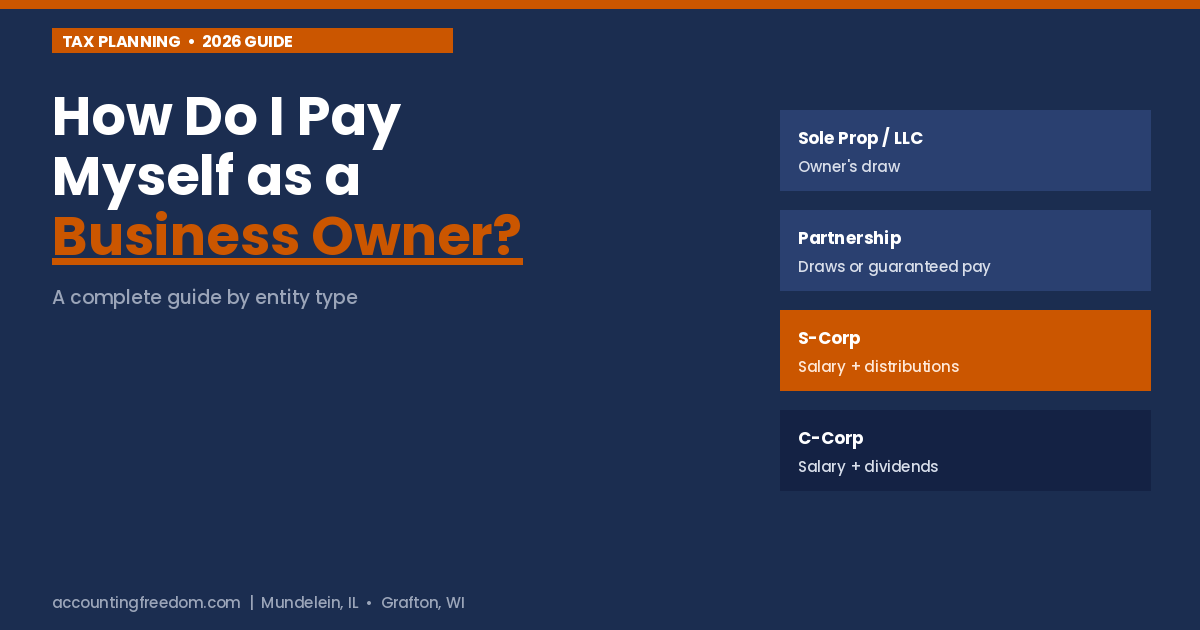
The short version: How you pay yourself as a business owner depends on your entity type. Sole proprietors and single-member LLCs take an owner’s draw — money moved from the business account to a personal account, with no payroll involved. Partnerships and multi-member LLCs use draws or guaranteed payments, reported on a Schedule K-1. S-Corp owners must take a reasonable W-2 salary before taking any additional distributions. C-Corp owners take a salary and can optionally receive dividends, which get taxed twice. One rule never changes regardless of structure: the IRS does not allow you to pay yourself as a 1099 contractor.
How to Pay Yourself as a Business Owner: The One Rule That Never Changes
Before getting into the specifics by entity type, here’s a rule that applies no matter how your business is set up: you cannot pay yourself as an independent contractor. The IRS doesn’t allow a business owner to issue themselves a 1099, because you can’t simultaneously be the employer and an independent contractor in the same business. Every legitimate way to pay yourself falls into one of three categories: an owner’s draw, a guaranteed payment, or a W-2 salary.
How to Pay Yourself as a Business Owner by Entity Type
Sole Proprietor or Single-Member LLC
How you get paid: An owner’s draw. You simply move money from your business account to your personal account. There’s no payroll system and no W-2 involved.
Taxes: The IRS doesn’t distinguish between you and your business at this structure, so there’s no formal salary option. You pay self-employment tax (15.3%, covering Social Security and Medicare) plus ordinary income tax on your net business profit — regardless of how much you actually draw out. Even profit you leave in the business account still gets taxed to you personally.
Reporting: You report business income on Schedule C, filed with your personal Form 1040.
Partnership or Multi-Member LLC
How you get paid: Owner’s draws, guaranteed payments, or both. A guaranteed payment is a fixed amount paid to a partner regardless of the business’s profit that year — similar in spirit to a salary, but it isn’t run through payroll and doesn’t have taxes withheld.
Taxes: Partners generally owe self-employment tax on both their share of business profit and any guaranteed payments received. Because nothing is withheld throughout the year, you’re responsible for making quarterly estimated tax payments yourself.
Reporting: Each partner receives a Schedule K-1 at tax time, showing their share of income, guaranteed payments, and deductions.
If you’re in a multi-member LLC or partnership, put a written payment schedule in place with your partners. Clear expectations about when and how much everyone gets paid prevent a lot of avoidable conflict.
S-Corporation
How you get paid: A reasonable W-2 salary first, then additional distributions from any remaining profit. This isn’t optional. If you actively work in the business, the IRS requires you to take a salary before taking any distributions at all.
Taxes: Your salary runs through payroll, with income tax and FICA taxes withheld like any other employee paycheck. Distributions, by contrast, aren’t subject to self-employment tax or FICA — which is exactly why S-Corp status appeals to profitable business owners. The catch is that your salary has to be genuinely reasonable for your role, industry, and the time you put in. The IRS defines “reasonable” as what you’d have to pay someone else to do your job.
Reporting: Your salary appears on a W-2. Distributions and your share of business income appear on a Schedule K-1.
For the full breakdown of what counts as reasonable and how to document it, see our post on salary vs. dividends and reasonable compensation.
C-Corporation
How you get paid: A salary, run through payroll like any employee. Beyond salary, C-Corp shareholders can also receive dividends from company profit — but dividends are optional. The business can retain earnings instead of distributing them.
Taxes: Your salary is deductible to the corporation and taxed once, to you personally. Dividends work differently: the corporation pays tax on its profit first (a flat 21% federal rate), and then you pay tax again on the dividend when you receive it. That’s double taxation, and it’s the single biggest factor in how C-Corp owners decide how much to take as salary versus dividend.
Reporting: Your W-2 shows your salary. Form 1099-DIV shows your dividends.
We cover the actual math behind double taxation, with real numbers, in our C-Corp salary vs. dividends guide.
How to Pay Yourself as a Business Owner: Side-by-Side Comparison
| Structure | Payment Method | Self-Employment Tax? | Tax Form |
|---|---|---|---|
| Sole proprietor / single-member LLC | Owner’s draw | Yes, on all profit | Schedule C |
| Partnership / multi-member LLC | Draws or guaranteed payments | Yes, on profit share + guaranteed payments | Schedule K-1 |
| S-Corporation | Salary + distributions | Salary only — not distributions | W-2 + Schedule K-1 |
| C-Corporation | Salary + optional dividends | No — but dividends face double taxation | W-2 + Form 1099-DIV |
How to Pay Yourself: When S-Corp Election Makes Sense
Many single-member LLC owners eventually ask whether they should elect S-Corp tax treatment to start paying themselves a salary plus distributions instead of a straight owner’s draw. The appeal is real: distributions avoid the 15.3% self-employment tax that applies to every dollar of draw income.
The tradeoff is administrative. An S-Corp requires running actual payroll, filing a separate business tax return, and maintaining the documentation to defend your “reasonable salary” if the IRS ever asks. Below roughly $80,000 in annual net profit, the added complexity and cost usually outweigh the tax savings. Above that level — and especially once you’re clearing $100,000 or more — the S-Corp election frequently saves real money.
Common Mistakes in How to Pay Yourself as a Business Owner
⚠️ Watch For These
- Paying yourself via 1099. Not allowed under any structure. If you’ve been doing this, it needs to stop immediately.
- Taking distributions before a reasonable S-Corp salary. This is one of the most common triggers for IRS scrutiny, and reclassification comes with back payroll taxes and penalties.
- Treating an owner’s draw as a business expense. A draw is not deductible to the business. It’s simply moving money you already owe tax on from one account to another.
- Skipping quarterly estimated payments. If nothing is being withheld from your draws or guaranteed payments, you’re responsible for sending the IRS estimated payments yourself, four times a year.
- Leaving all profit in the business and forgetting you still owe tax on it. At a sole proprietorship, partnership, or standard LLC, you’re taxed on your share of profit whether or not you actually withdraw the cash.
What This Means for Illinois and Wisconsin Business Owners
How to pay yourself isn’t a decision to make once and forget. As your income grows, the right structure and the right salary-to-distribution split can change — sometimes significantly. A compensation approach that made sense at $75,000 in profit often stops being optimal at $150,000.
If you’re not sure whether your current setup is still the right one, or if you’re deciding between entity structures for the first time, that’s exactly the kind of conversation worth having with an advisor before your next filing — not after. For a deeper look at retirement contributions tied to how you pay yourself, see our guide to SEP-IRA vs. Solo 401(k) vs. SIMPLE IRA. And if you’re weighing whether to bring on your first employee alongside how you pay yourself, our post on 1099 vs. W-2 classification covers that decision in detail.
Use our pricing calculator to see what proactive tax planning costs, or take our two-minute package assessment to see which tier fits your business right now.
Not sure if you’re paying yourself the right way?
A free consultation gets you a real answer based on your actual numbers and structure — not a generic rule of thumb.
Schedule a Free Consultation See Our PricingDisclaimer: This article is provided for general informational purposes only and does not constitute tax, legal, accounting, or financial advice. How you should pay yourself depends on your specific business structure, income, and goals. Before acting on anything in this article, consult with a qualified tax advisor. Reach out to Accounting Freedom for guidance specific to your situation.
About the Author
Frank Fiore, CPA — President & Visionary, Accounting Freedom
Frank Fiore has spent 20+ years helping small business owners in Illinois and Wisconsin figure out the right way to pay themselves as their business grows. Accounting Freedom serves clients from offices in Mundelein, IL and Grafton, WI.